
July 2026 Portfolio Update
Conviction paying off; 11.2% portfolio return


Hi there,
The portfolio has done well over the past few months, and July was no exception, with a return of 11.2%, compared to ~0% for the S&P 500.
One of the hardest parts of investing is watching your highest-conviction ideas get cheaper while everyone else is, or at least seems to be, outperforming.
Earlier this year, that is exactly what happened. While software stocks remained deeply out of favor, I continued adding to several of my highest-conviction positions, including Amazon, Topicus, Adobe, and Duolingo.

Staying disciplined and adding to high-conviction names in my portfolio while they were cheap has been rewarding so far. July brought strong earnings reports from my holdings, including Amazon, which grew AWS at 37% YoY, as well as Basic-Fit, which continues to show strong operating leverage.

In addition to that, the market rotated out of the most popular AI names this month (e.g. Micron, Sandisk, ASML), into hyperscalers and quality stocks in general.
As a result, since March, when both the portfolio and the broader market reached their deepest drawdowns, the portfolio has returned roughly 20%, compared to around 10% for the S&P 500.
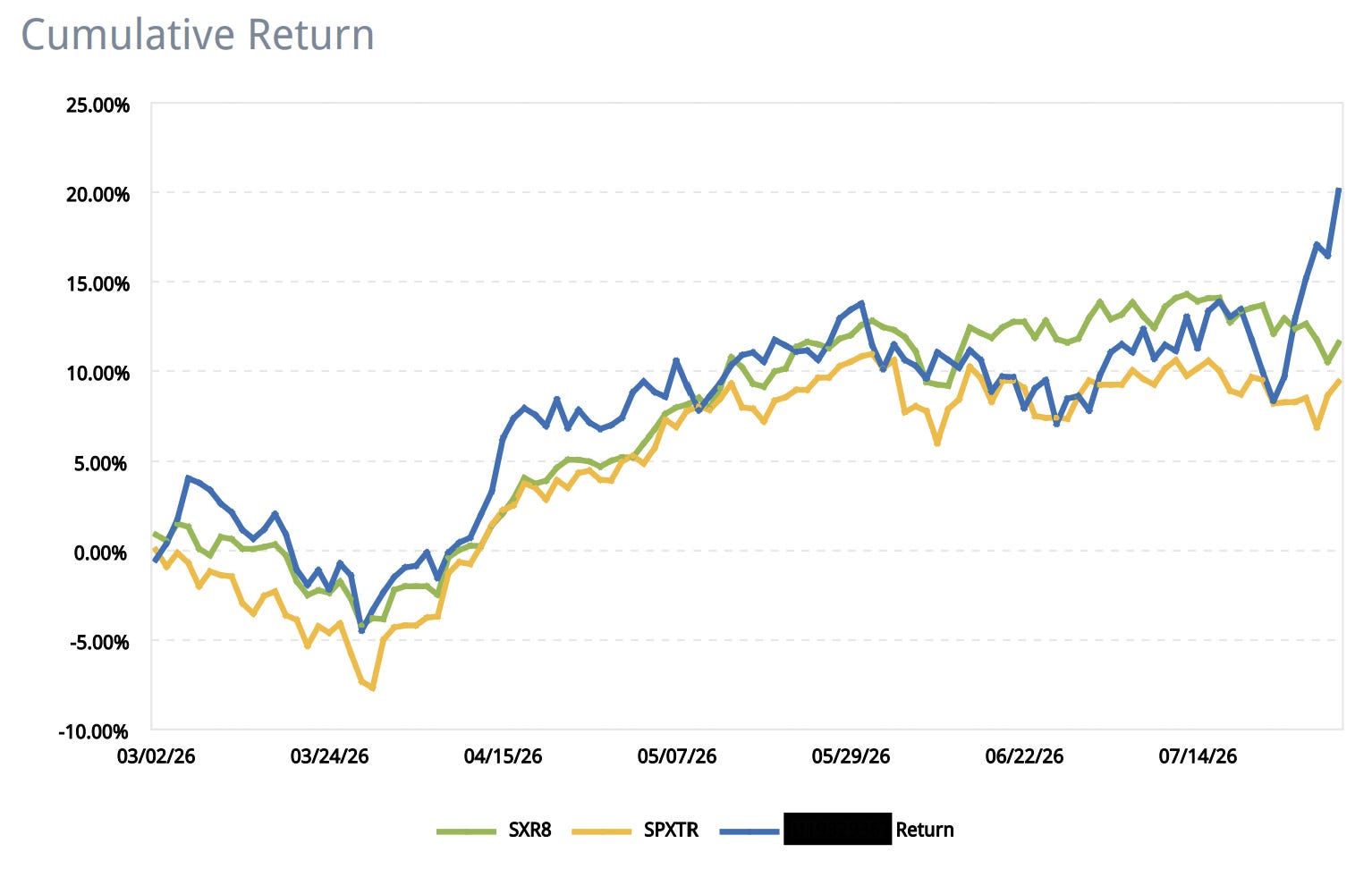
While this is just a short period, I expect my stock picks to continue compounding and delivering strong results.
In this portfolio update, I want to briefly discuss the importance of conviction within this context, after which I will cover the portfolio in more detail.
Investing Is a Mind-Game
Conviction is a strong belief in an idea or opinion. Conviction is only conviction when that belief does not change easily.
The problem is that investors are bombarded with information every day, all of it encouraging them to change that conviction. You may immediately think of Wall Street headlines, financial shows, or journalists claiming to have found the next big winner.
But I believe the most influential, and most dangerous, piece of information is the stock price itself.
Businesses change slowly over time, while earnings are reported quarterly. Stock prices, however, change every second. Because prices update constantly while fundamentals do not, our brains naturally give stock prices more weight. We begin to confuse changes in price with changes in business quality.
In other words, we let stock prices dictate our sentiment, or even worse, our conviction.
Over the long term, stock prices and business fundamentals move together. But in the short term, it is not that simple.
When Alphabet traded at ~$150 in 2025, no one wanted to own it. Today, with the stock trading at ~$370, everybody wants to own it.
We may be seeing something similar with Amazon today, although only time will tell. Now that Amazon’s shares are climbing higher, people want to own the stock. When shares were closer to $200, very few did.
The point is that, as an investor, you own actual businesses, not stock prices. If your conviction is based on the strength of the underlying business, a falling stock price alone should not suddenly change your mind. A lower share price does not automatically mean a weaker business.
Over the past few months, I have been able to take advantage of this phenomenon. By staying disciplined, stepping back from the stock price, and focusing only on the fundamentals, I have been able to buy more shares of high-quality businesses at prices well below today's.
The portfolio is now in what I believe is an extremely healthy position, with more compounding and growth ahead.
Portfolio Update
As of July 31, the portfolio consists of the following holdings:
